With global energy storage installations accelerating at an unprecedented pace, safety has become the industry’s top priority. There is a major shift from traditional reactive firefighting measures to a proactive, safety-by-design approach that covers the entire product lifecycle.
Recently, HyperBlock III passed the large-scale fire test under the witnesses by CSA Group. After a 16-hour burn, the 5 MWh energy storage system demonstrated exceptional resilience, achieving zero thermal propagation and setting a new safety benchmark within the industry.
Limitations and Challenges of Passive Fire Protection
1. Definition and Common Forms
The core concept of passive fire protection is to detect and respond to a fire after it has already broken out. Common methods include gas suppression systems, sprinklers, firewalls, and physical spacing. These focus entirely on damage control rather than stopping the root cause.
2. Core Deficiencies
- Delayed Response: It cannot prevent the initial thermal runaway. By the time a sensor trips and the system discharges, the chemical reactions inside the battery are typically already self-sustaining and spreading.
- High Risk of Re-ignition: Standard agents like aerosols or Heptafluoropropane are effective at knocking down open flames, but they are unable to penetrate the battery module to cool the core temperature. As a result, the continuous heat accumulation within the battery makes it highly susceptible to re-ignition even after visible flames have been extinguished.
- Inadequate Capacity for Large-scale Incidents: In massive, long-duration energy storage fires, once the heat release exceeds the design envelope, passive measures are quickly overwhelmed. This leads to an uncontrollable situation and, ultimately, a total loss of the asset.
Technological Advantage of HyperBlock III
HyperBlock III establishes a multi-layered active safety architecture, covering cell, module, cabinet, and system. By integrating AI-driven early warning technologies, the system marks a definitive leap from reactive response to proactive suppression.
1. Cell Level
HyperBlock III is engineered with advanced safety-focused material innovations to enhance stability under extreme conditions:
- A flame-retardant electrolyte helps capture free radicals at elevated temperatures, interrupting chain reactions and slowing the onset of thermal runaway.
- The ceramic-coated separator could keep structural integrity above 200°C, effectively preventing direct contact between anode and cathode.
These materials widen the cell’s thermal tolerance, decreasing the likelihood of thermal runaway at the chemical source.
2. Module Level
HyperBlock III incorporates a cabin-level aerosol insulation layer, establishing an efficient thermal barrier between individual battery cells.
At the same time. The directional pressure-relief and venting technology creates a unidirectional exhaust channel for high-temperature gases.
3. Cabinet Level
Each cabinet is equipped with an independent flame-retardant airflow duct, stopping flames and hot gases from spreading through shared ventilation paths.
When an anomaly is detected, the automatic liquid-cooling loop isolation mechanism instantly cuts off coolant circulation. This avoids the risk of coolant vaporization and potential combustible vapor explosions under high temperatures.
4. System Level
The cabinet has stronger structural integrity and a heat-resistant coating. This keeps neighboring cabinets safe from heat radiation.
Supported by the HyperStrong AI platform, HyperBlock III sets up a model of battery behavior based on extensive historical data.
By tracking millisecond-level fluctuations in voltage, temperature, and impedance, the system is able to identify subtle nonlinear deviations. It can issue ultra-early warnings from several minutes to tens of minutes before thermal runaway.
Even under prolonged high-temperature exposure, the BMS in adjacent enclosures maintained stable operation with uninterrupted data communication.
5. Large-scale Fire Test of HyperBlock III
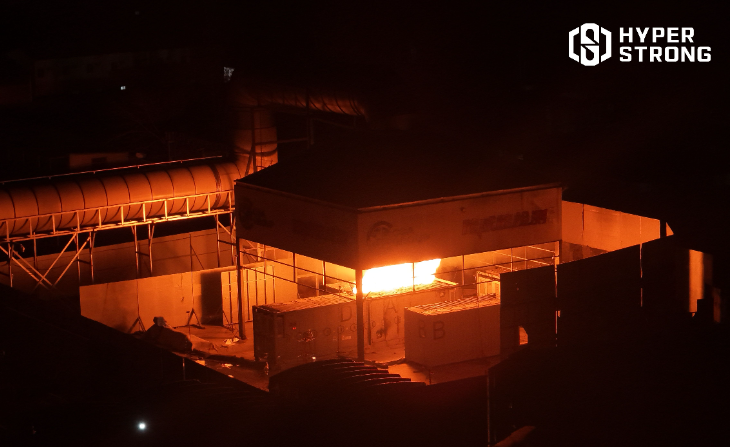
(1) Thermal Propagation Blocking
During the test, the peak temperature reached 1,400°C. However, the adjacent components – the liquid cooling unit and the electrical control cabinet showed no signs of fire damage.
In neighboring cabinets, the highest recorded cell temperature remained below 35°C, with no evidence of thermal runaway or fire spread throughout the entire test.
(2) Structural Integrity
After 16 hours of burning, the cabinet structure stayed intact. The door remained locked the whole time. No structural collapse or flame escape happened.
(3) System Sensing
The BMS units in four neighboring cabinets ran without any interruption. The data links stayed open. Temperature and voltage readings from thousands of cells streamed to the cloud platform in real time, with updates every millisecond. The platform automatically spotted unusual temperature rise trends and sent out warnings ahead of time.
The Value of Active Safety Design
1. Asset Protection
In a 16-hour extreme fire test, the temperature inside the cabinets adjacent to the burning unit remained below 35°C. This indicates that even in a situation of complete failure of a single cabinet, the batteries in the neighboring cabinets can remain unaffected, effectively preventing thermal propagation and a cascading loss of assets.
The damage ranges from losing the entire station to replacing just one cabinet, greatly reducing financial losses from a single incident and reducing insurance claim pressure.
2. Operations & Maintenance Support
Under extreme conditions, HyperBlock III maintained stable operation of both the BMS and communication networks. Therefore, firefighters can access real-time battery status data, remotely manage cooling system operations, and assess potential re-ignition risks, making emergency response much safer and more effective.
At the same time, the continuous, tamper-resistant data stream provides a reliable evidentiary record for post-incident insurance evaluation and root cause analysis.
3. Full Lifecycle Safety Coverage
HyperBlock III creates a closed-loop safety management system that covers every dimension: design, operation, emergency response, and post-incident analysis. It provides energy storage stations with long-term, reliable protection and advances energy storage safety standards from experience-driven to data-driven.
Conclusion
The energy storage industry is evolving beyond passive fire protection, as post-ignition detection is no longer sufficient and suppression without effective thermal management can still lead to re-ignition. Large-scale incidents continue to carry the risk of total system loss.
HyperBlock III addresses these challenges with an integrated active safety approach from cell to system, supported by AI-driven monitoring and validated through a 16-hour extreme fire test. The system is designed to protect adjacent assets and communication integrity, turning a potential chain reaction into a single cabinet replacement.Take the next step. Reach out to HyperStrong for the full test report, a product demo, or to speak with their safety engineering team.