

Introduction
Global trade has become more connected and competitive than ever before. Businesses of all sizes are looking beyond local markets to find new customers, reliable suppliers, and profitable opportunities. However, entering international markets is not simply about finding a country to sell products to or locating a supplier overseas. Companies need accurate insights into market demand, competitor activities, customer behavior, and supply chain movements.
This is where global import export data becomes increasingly valuable.
By analyzing global import export information, businesses can understand how products move between countries, identify emerging market trends, discover potential buyers, and make more informed decisions. Instead of relying only on assumptions or traditional research methods, companies can use real trade data to develop strategies based on actual market activities.
What Is Global Import Export Data?
Global import export data refers to detailed information about international trade transactions between countries. It usually includes product details, HS codes, importing and exporting countries, shipment quantities, trade values, suppliers, buyers, and transaction records.
For businesses involved in international trade, this data provides a clearer picture of the global marketplace.
For example, a company planning to export agricultural products can use global import export data to understand:
- Which countries have increasing demand for the product
- Who the major importers are
- Which suppliers are already active in the market
- How frequently competitors ship products
- What price levels and trade volumes are common
With these insights, companies can reduce uncertainty and create more effective market entry strategies.
Why Global Import Export Data Matters for Businesses
1. Understand Market Characteristics and Trends
Every international market has unique characteristics. Consumer preferences, purchasing cycles, supplier relationships, and competition levels can vary significantly between countries.
Before expanding into a new market, businesses need to understand local demand and industry trends.
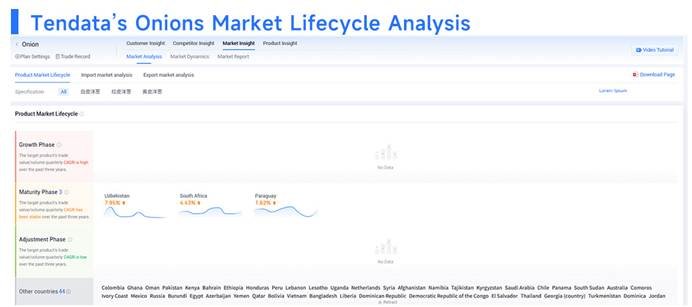
Platforms like Tendata help companies analyze global trade flows, identify top importing and exporting countries, and gain deeper market insights through customs data.
For instance, companies researching the onion market can use HS code 070310 to explore:
- Main importing countries
- Export origins
- Changes in trade volume
- Market demand patterns
These insights help businesses better understand where opportunities exist and how to position their products.
2. Analyze Competitor Activities
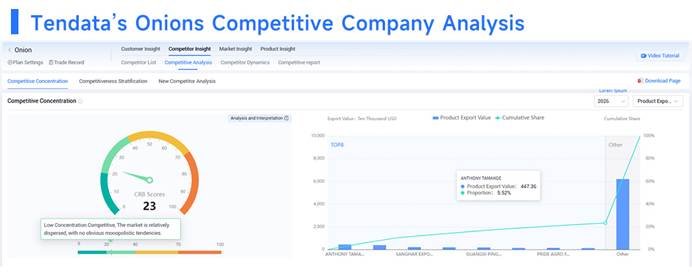
Competition is one of the most important factors in global business expansion. Before entering a market, companies need to understand who their competitors are and how they operate.
Global import export data allows businesses to monitor competitor movements, including:
- Their export destinations
- Shipment frequency
- Product categories
- Supply chain relationships
- Estimated transaction patterns
Through this information, businesses can identify competitor strengths and weaknesses and discover potential market gaps.
For example, if several competitors are supplying a specific market, a company can analyze their shipment patterns and explore opportunities to differentiate through pricing, product quality, delivery speed, or customer service.
Tendata provides trade intelligence tools that allow users to track competitors’ activities and analyze supply chain trends. These insights help companies make more strategic decisions instead of competing blindly.
3. Develop More Effective Sales Leads
Finding reliable buyers is often one of the most difficult parts of international trade. Traditional methods such as general business directories or online searches may provide limited information.
Global import export data offers a more targeted approach by showing companies that are already actively involved in international transactions.
With trade data, businesses can identify:
- Active importers
- Purchasing frequency
- Order quantities
- Supplier relationships
- Buying patterns
For example, an onion exporter can use Tendata to discover potential buyers based on HS code 070310. The platform helps users analyze buyers’ purchasing habits, transaction volumes, and import cycles, making it easier to prioritize valuable prospects.
Tendata also includes a built-in contact database that provides access to decision-makers’ contact information, including emails, LinkedIn profiles, and Facebook profiles. This enables businesses to connect with potential partners more efficiently and support direct outreach.
Improving Supply Chain Decisions With Trade Intelligence
Global supply chains are becoming more complex due to changing market conditions, transportation challenges, and economic uncertainty.
Companies need visibility into supplier networks and international trade movements to manage risks effectively.
By analyzing global import export data, businesses can:
- Evaluate supplier reliability
- Identify alternative sourcing markets
- Monitor changes in trade relationships
- Predict potential supply chain risks
For importers, this information helps them find suitable suppliers and compare different sourcing options. For exporters, it helps them understand buyer demand and adjust their sales strategies.
Choosing the Right Global Import Export Data Platform
Not all trade data platforms provide the same level of information. Businesses should consider several factors when selecting a solution, including:
- Data coverage across countries and industries
- Accuracy and update frequency
- Search capabilities by product or HS code
- Buyer and supplier information
- Market analysis features
A reliable platform should not only provide raw trade records but also help businesses turn data into actionable insights.
Tendata is a one-stop paid customs data platform designed to help companies explore global trade opportunities. Through global import export data analysis, businesses can understand market characteristics, monitor competitors, and develop high-quality leads.
Whether companies are searching for new export markets, evaluating suppliers, or identifying potential buyers, trade intelligence tools can make international expansion more efficient and data-driven.
Conclusion
In today’s competitive global marketplace, businesses cannot rely only on experience or traditional market research. Access to accurate global import export data provides valuable insights into international trade activities and helps companies make smarter decisions.
From discovering market opportunities and analyzing competitors to finding qualified buyers and improving supply chain strategies, global import export data has become an essential resource for businesses expanding worldwide.
With platforms like Tendata, companies can transform complex trade information into practical business opportunities, allowing them to better understand markets, connect with the right partners, and build stronger global strategies.