

Some people say:
“Global trade database is better for background checks than for customer acquisition. Don’t expect to steal customers with it.”
I agree with half of that.
Yes, trying to “poach” existing customers purely from trade data usually has low efficiency.
But the problem isn’t the data—it’s how most people use it.
Most exporters treat a list of company names as “customers.”
In reality, global trade database gives you a pool, not a ready-made customer list.
Here’s how to use it correctly.
1. Data Gives You a Pool, Not Customers
Search for a single HS code—for example, HS Code 854143 in Tendata—and you might see:
·14,000+ buyers
·10,000+ suppliers
·150,000+ trade records
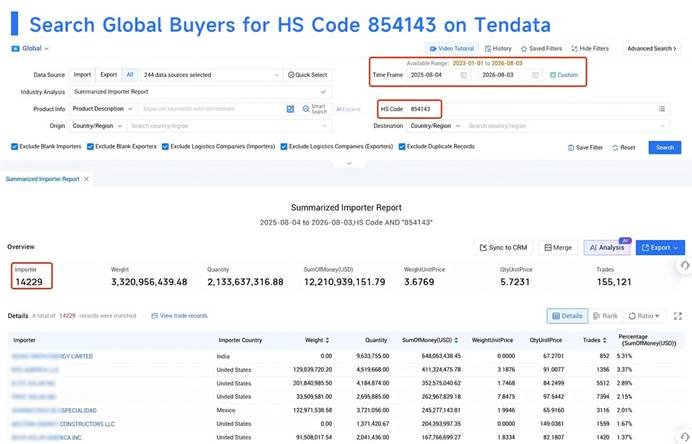
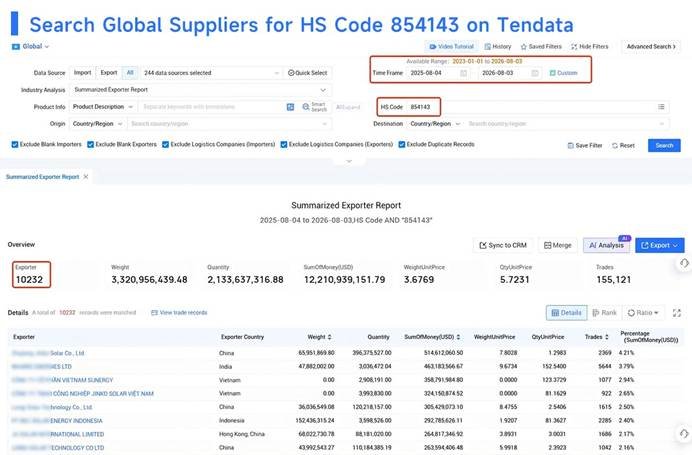
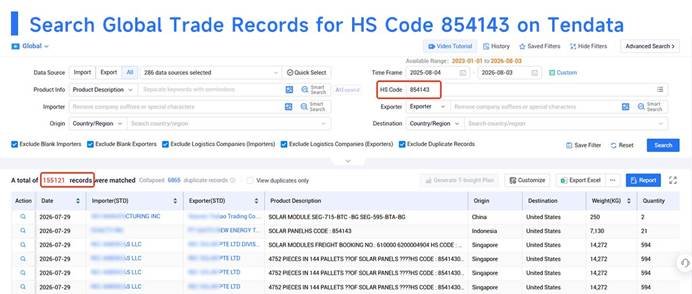
At first glance, 14,000 buyers looks like a gold mine.
But if you export that list and send cold emails to everyone, your conversion rate will be so low that you’ll start doubting whether trade data works at all.
The truth is: a large portion of those companies will never reply to your outreach.
Some aren’t real buyers. Some aren’t reachable. Some simply don’t fit your profile.
The list is a starting point—not a shortcut.
2. Some Buyers on the List Are Off-Limits
Look at the top buyers for that HS code. Many have procurement volumes in the billions of dollars. They look like dream clients.
But when you check their corporate structure, you realize:
These are often the overseas sales entities of module manufacturers themselves.
For example, the #1 U.S. buyer in the list is importing from its own factory in Vietnam.
That’s internal group flow—not open-market procurement.
You can send 100 outreach emails. It won’t matter. Their “supplier” is themselves.
A little further down the list, you’ll find buyers with smaller volumes—but these are the real third-party purchasers who actually choose suppliers in the open market.
So the first step isn’t “export the list.”
It’s: classify each company.
·Internal group transfers
·Traders and re-exporters
·End buyers making real purchasing decisions
The number of invalid targets you eliminate at this stage is often larger than all the effort you’ll spend later on outreach.
Most people skip this step, then conclude: “Global trade database doesn’t work.”
3. One Digit Wrong in the HS Code, and the Whole Pool Is Wrong
There’s an even subtler trap.
A single-digit difference in the HS code can shift you up or down the supply chain. Two similar HS codes can show completely different sets of companies—with different decision-makers, priorities, and procurement cycles.
Names can be misleading too. You need to check legal entities.
For example, JA Solar:
·Under HS 854142, you might see their Vietnam factory
·Under HS 854143, you might see their U.S. or Singapore sales entity
Get the HS code wrong by one digit, and your entire “prospect pool” is misaligned.
And the system won’t warn you.
You’ll just see “no replies” and assume your email copy is bad—when in fact you’re targeting the wrong role in the supply chain.
4. So How Should You Actually Use Trade Data?
Here’s my conclusion:
The real value of global trade database isn’t in giving you a one-time list.
It’s in giving you a fixed pool to monitor over time.
Lists are static.
What’s valuable is change.
Watch for signals like:
·A buyer suddenly reduces purchases from their current supplier
→ They may be negotiating price, testing new suppliers, or facing delivery issues.
·A buyer adds a second or third supplier
→ They’re actively diversifying risk.
·A buyer’s import volume is growing, but their supplier base hasn’t changed
→ Their current supplier may be struggling to keep up.
When these signals appear, your outreach has a completely different success rate compared to cold-start prospecting.
You’re no longer targeting “a customer.”
You’re targeting “a customer who is actively reconsidering their supply chain.”
Using global trade database as a one-off list harvest is indeed low-efficiency.
Using it as a continuous signal-monitoring system is where the real leverage lies.
One is a single shot.
The other is a long-term asset.