If you keep hearing “cobot,” “laser,” and “automation,” you are not alone in feeling cautious. The terms can be confusing, programming and safety can sound costly to learn, and spec sheets full of payload and repeatability numbers rarely explain what will change in your workflow. A well-designed cobot laser welder tackles all three by pairing a collaborative robot with laser welding, enabling repeatable paths and scaling what works.
A Real-World System Example
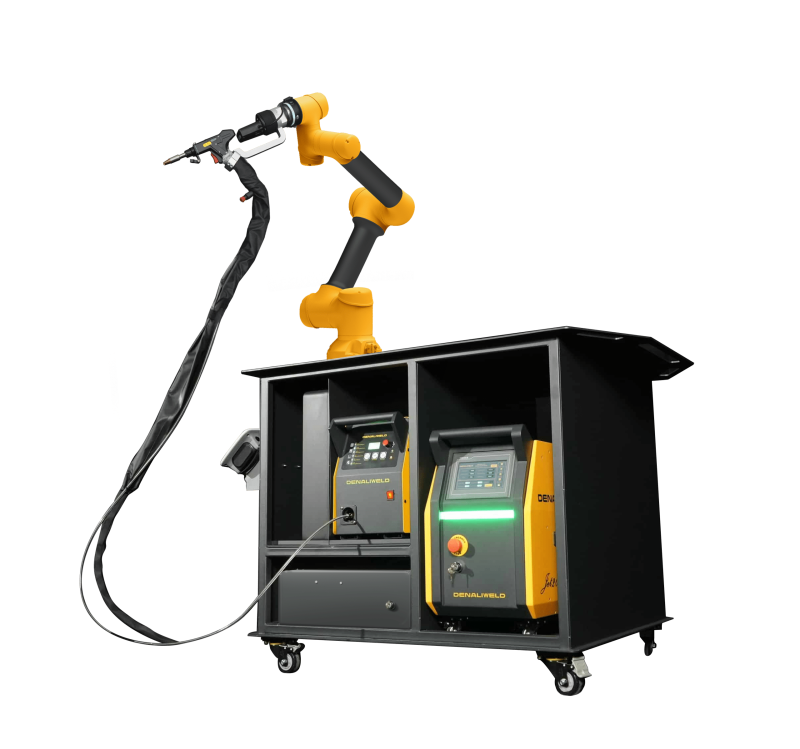
A practical way to judge any setup is to look for features that shorten changeovers and make results easier to verify. Denaliweld describes its Cobot Series as a modular system with one-click switching between manual and automated operation, welding data acquisition for tracking performance, and optional seam tracking for improved joint alignment. Your cobot laser welding setup should support your workflow from setup to repeatability to basic traceability.
Defining a Cobot Laser Welder
What “Cobot” Means in Welding Automation
A collaborative robot is designed to work closer to people than traditional industrial robots when your cell is properly risk-assessed and protected. In welding, the benefit is flexibility. You can teach paths faster and adapt to short runs without a major footprint. In practice, a cobot laser welder helps you turn a good manual technique into a repeatable program, as long as your safeguards and procedures are solid. For safety context, see ISO/TS 15066.
What Makes It a “Laser Welder”
Laser welding joins metal by focusing energy into a small spot, allowing you to control heat input on suitable joints. The process rewards consistency. Fit-up, focus position, and travel speed matter, so stable fixturing and repeatable motion are essential. For a high-level refresher on hazards and safeguards, review the basics of laser safety.
Key Elements of a Cobot Laser Welding Setup
Robot Arm and Controller Basics
The arm handles multi-axis positioning, while the controller runs the path and coordinates signals like start, stop, and interlocks. What matters to you is usability: can you teach a job quickly, save it reliably, and make small edits without reworking everything?
Laser Welding Machine and Welding Head
The laser source generates the beam, and the welding head focuses and delivers it to the joint. A production-ready setup also manages cooling and beam delivery, ensuring stable performance during longer runs. Guarding, interlocks, and a clear “safe to operate” workflow should be in place before you run parts.
Optional Seam Tracking and Sensing
Parts vary, even with good drawings. Seam tracking can help keep the tool centered, probing can help you locate a reference edge, and monitoring can flag when a run drifts. These options do not replace good fixturing, but they can reduce rework when variation is unavoidable.
How It Works Step by Step
Programming and Job Setup
You define a weld path, choose process parameters, and then validate on test pieces. Teaching can be as simple as recording points and motions, then setting power, speed, and focus. Keep a short record of what you changed between trials so future changeovers are faster.
Automated Welding Execution
During the run, motion and laser output are synchronized so the beam is active only where it should be. Consistent starts and stops are where automation often pays off, especially on repeating joints. Check how the system handles part loading, safe stops, and recovery after a fault because those moments determine real uptime.
Monitoring and Welding Data Capture
Monitoring can include job history, alarms, and parameter logs. Even basic data helps you pinpoint whether the cause is settings, fit-up, or a fixture shift. Over time, that feedback loop reduces guesswork and enables you to standardize quality.
Integration, Changeover, and Operating Environment
Switching Between Manual and Automated Operation
Many shops need both manual flexibility and automated repeatability. Quick switching lets you tack or fit by hand, then run a programmed weld when the setup is stable. It also supports training by allowing you to introduce automation in stages.
Compatibility Considerations
Integration issues usually come from interfaces and utilities. Confirm how the controller communicates with the laser, what electrical service and cooling are required, and how cables are routed so they do not snag—plan for fume management and guarding early.
Environmental and Protection Ratings
Dust, grinding residue, vibration, and temperature swings can affect reliability. Ingress protection ratings and ambient limits are clues about how well equipment will tolerate your environment. Match the rating to your reality so maintenance surprises do not undermine process stability.
Typical Performance Specs and What They Indicate
Payload, Reach, and Repeatability
Payload is the total tool weight the arm can carry, including the head, cables, and sensors. Reach tells you whether the arm can access the joint without awkward fixtures. Repeatability affects seam placement consistency.
As a concrete example, Denaliweld lists cobot models with 5 kg, 10 kg, and 16 kg payload options, working radii from 917 mm to 2000 mm, and repeatability values ranging from ±0.02 mm to ±0.05 mm. Use figures like these to confirm reach and tooling fit, then focus on joint design and fixture stability.
Speed, Power, and Facility Interfaces
Top speed is rarely the limiting factor. Weld quality depends on stable motion at your process speed. Facility needs can be more important: power, cooling, and reliable communication between components. Plan these early to avoid compromises during installation.
Maintainability and Modular Service Considerations
Automation succeeds when downtime is predictable. Modular service design helps because components can be replaced without tearing down the whole cell. Look for clear access to optics and wear items, and for troubleshooting that points to a likely cause.
Conclusion
A cobot laser welder guides a laser welding head along a repeatable path while managing safety signals and capturing information you can use to improve. If you evaluate it through your real constraints, such as fixtures, changeovers, and maintenance access, the specs become meaningful instead of confusing. With that clarity, you can make a confident decision and include Denaliweld in your shortlist as one example of a flexible, data-aware system.